


Discover our Transformative Executive Functioning & Attention Programs
These groundbreaking programs target the core building blocks integral to executive functioning, attention, and motivation. Rather than merely addressing symptoms, it delves into the root causes. This leads to authentic development instead of reliance on compensation, memorized rules, isolated skills, medication, or willpower.
Explore our effective method for pursuing self-improvement. These programs empower individuals to function more effectively and successfully at school, work, or home. They also offer a helpful framework for employees and employers aiming to foster positive change through effective strategies and a shared understanding to navigate challenging situations.
These programs are ideal for anyone aged eight and up who seek to:
-
Reduce stress/anxiety
-
Manage time efficiently
-
Improve focus
-
Enhance organization
-
Create more order in their life
-
Improve relationships and communication
-
Boost motivation
-
Increase emotional regulation
-
Confidently make positive decisions
-
Learn to effortlessly embrace responsibility to achieve success
Program Flow
Our Executive Functioning and Attention Programs offer a holistic and positive approach addressing the root source of challenges. We provide effective and proven tools and strategies to foster meaningful change in your life. Our goal is to help you leverage your unique learning abilities and strengths, transforming your challenges into opportunities for growth and success.
Science agrees that all people progress through a series of developmental stages. However, some might not fully progress through all the stages; may miss pieces; or even skip entire steps. When this happens, it can create gaps in an individual’s skills as they continue to develop.
The missing pieces define the areas and degree of one's challenges. We all have some gaps, and everyone can benefit from this program. However, when an excessive number of pieces are missing, it can impede one's ability to reach their full potential. Too many missing pieces can lead to a diagnosis of ADHD or other executive functioning disorders.
By systematically and thoroughly filling in these gaps, problematic characteristics begin to diminish, and natural growth occurs. This process removes barriers, supports lifelong learning, and enables full participation in life. To achieve one's full potential, three stages must be addressed: individuation, identity development, and social integration. Learn more about these stages in the tabs below:
Pre-Screening
-
Informational Webinar:
This introduction will acquaint you with the core philosophy, tools, strategies, methodology, and purpose of our programs, highlighting how we can support you or your loved one. -
Online Intake Forms:
Recognizing that everyone is unique, this information will help us understand your specific situation and identify the most suitable approach to achieve your goals. -
Consultation:
After the forms are submitted and thoroughly reviewed, both parties may have questions. This stage is our opportunity to gain a deeper understanding of whom we are working with, while offering you a clear overview of what your personalized program will entail. It is crucial that the program focuses on the client's interests, motivations, and goals. -
Registration and Deposit:
Reserve your date and receive your confirmation packet.

Common Characteristics
Every person is unique, with their own set of strengths and challenges. For neurodivergent individuals, such as those with ADHD or difficulties in executive functioning, symptoms and their severity can differ considerably.
ADHD is often marked by inattentiveness, impulsivity, and hyperactivity, which are frequently accompanied by issues in executive functioning. While many with ADHD display traits across these areas, this is not always the case. For example, around 20-30% of individuals struggle with concentration and focus without experiencing hyperactivity or impulsiveness. This was previously known as attention deficit disorder (ADD). Currently, ADHD is categorized into three types:
-
ADHD, Inattentive Type
-
ADHD, Hyperactive Type
-
ADHD, Combined Type
In Canada, it is estimated that 5-7% of children and 4-6% of adults have ADHD.
Individuals with ADHD often experience emotions differently, with emotional dysregulation—difficulty managing emotions—affecting about 1 in 3 children and 1 in 2 adults with ADHD.
Executive function skills are vital for handling everyday tasks such as planning, organizing, prioritizing, focusing, executing tasks, solving problems, and adapting to new situations. Research shows that strong executive functioning skills have a significant impact on mental and physical health, as well as overall quality of life. Weaker skills can influence academic performance, job stability, and social connections.
While everyone occasionally can exhibit these behaviours, for those with Executive Functioning challenges or ADHD, these behaviours are often the norm rather than the exception.
Below is a list of behaviours, feelings, and attitudes commonly observed in individuals with ADHD or Executive Functioning challenges. It's crucial to note if these characteristics appear across various settings: at home, school or work, during leisure activities, or in social situations. If you observe 15 or more of these symptoms affecting different areas of your life, it may be time to explore further. Please reach out to us, and we can assist you find solutions that capitalize on your strengths.
Common Co-occurring Diagnosis
Neurodiverse diagnoses often coexist with a variety of other conditions, such as executive functioning struggles, anxiety disorders, and learning disabilities. It’s important to take a comprehensive approach that addresses these coexisting conditions, tailoring support and intervention strategies to meet the individual's unique needs and enhance their overall well-being. At Rocky Point Academy, we strive to provide a supportive environment that recognizes and addresses these complexities, empowering participants to reach their fullest potential. For more information on our Learning Programs, please visit our Learning Page.
AD(H)D ▶️
Struggles with energy, focus, and impulsivity
Anxiety Disorder
Excessive fear/worry about everyday experiences.
Asperger's Syndrome
Autism with a high level of functionality.
Auditory Processing Disorder
Struggles with receptive language.
Developmental Reading Disorder
Struggles with processing language symbols.
Dyscalculia
Struggles with math.
Dysgraphia ▶️
Struggles with writing.
Dyslexia ▶️
Struggles with reading or spelling.
Dyspraxia ▶️
Struggles with coordination.
Gifted
Particular strength in one or more areas.
Hyperactivity
Struggles with controlling energy levels.
Learning Disability ▶️
Unexplained struggles with learning.
Low Executive Functioning ▶️
Struggles with planning, organizing, time management, remembering details, and following directions.
Non-Verbal Learning Disability
Struggles with responding to social cues.
Phonological Disorder
Inability to use some of the speech sounds.
Scoptic Sensitivity Syndrome
Also called visual dyslexia.
Sequencing Disorder
Struggles with sequencing.
Speech or Language Impairment
Struggles with expressive language.
Tourette's Syndrome
Involuntary movement, sound, and/or language.
Visual Processing Disorder ▶️
Another name for dyslexia.

The Gift Within
Embracing neurodivergence as a gift is about recognizing and valuing the unique strengths and perspectives that often accompany it. For example:
-
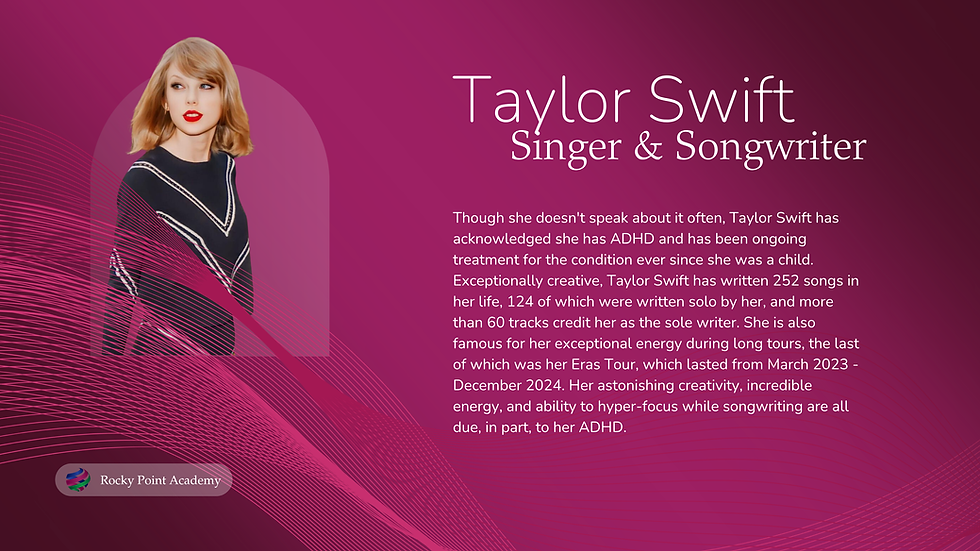
Those struggling with ADHD are over 300 percent more likely to start their own business.
-
An estimated eight to ten percent of all pro athletes struggle with ADHD symptomology, as compared to four to six percent of the neurotypical adults.
There is significant research that supports the idea that neurodiverse individuals are superior in:
-
Creativity and Innovation: A natural ability to think outside the box. This diverse thought process can lead to innovative problem-solving and creative solutions.
-
Strong Intuition: A keen sense of intuition and making quick decisions simply by following their 'gut feelings.'
-
Hyperfocus: While attention can be a challenge at times, neurodiverse individuals may experience hyperfocus, becoming intensely absorbed in activities they are passionate about. This can lead to exceptional productivity and mastery in areas of interest.
-
High Energy and Enthusiasm: The energy levels associated with neurodiversity can be channelled positively, driving enthusiasm and passion that inspire others and fuel dynamic projects and ideas.
-
Adaptability: Living with neurodiversity often requires flexibility, equipping individuals with the ability to problem-solve more readily than others.
-
Empathy and Sensitivity: Although slowing down to recognize the needs of others can be a struggle, many are extraordinarily empathetic, sensitive, and loyal.
-
Resilience: Navigating the challenges associated with neurodiversity can build resilience and determination, empowering individuals to persevere and succeed despite obstacles.
These individuals often excel in creative environments, whether that be art, music, technology, trades, or inventive/creative outlets. It's all about harnessing these traits, providing tools and strategies, and filling in missing concepts, so individuals with neurodiversity can thrive. At Rocky Point Academy, we aim to nurture these strengths, allowing each individual to reach their fullest potential.


We Use Developmental Therapy
Our programs at Rocky Point Academy focus on developmental therapy, emphasizing the holistic growth of the individual through natural interactions and experiences.
Developmental Therapy (Our Approach):
Approach: Focuses on the individual's overall development, highlighting emotional, social, and cognitive growth. It engages the individual in meaningful hands-on activities that aligns with their interests, promoting natural growth and smooth integration into daily life.
Core Beliefs: Learning is viewed as a dynamic process, with emphasis on the fundamental building blocks from which all learning is derived. Understanding the individual's developmental stage is crucial; working within their capacities promotes growth and leads to new behaviours.
Drive: Motivation from within drives the change.
Behavioural Therapy:
Approach: Employs structured, goal-oriented methods to modify specific behaviours. The focus is on promoting desired behaviours and diminishing unwanted ones using reinforcement techniques.
Core Beliefs: Operates on the principles of behaviour modification, based on the idea that behaviours can be learned or unlearned in response to external stimuli.
Drive: Change is driven by external rewards.


The Power of Clay
Do you find yourself or a loved one repeating the same negative behaviour over and over again? Perhaps you constantly find yourself being late, despite the fact that you are always feeling rushed. Or maybe you have a child who has been told every day, “Remember your lunch, remember your agenda, and don’t forget your mitts…” and still you find yourself delivering things to school on a weekly basis.
Why is it that even though the desire to change a behaviour is there — the negative behaviour continues to repeat itself?
The answer can be found in the underlying concepts which establish our behaviours; concepts such as change, consequence, time, sequence and order. If these underlying concepts are missing, it will always feel like an uphill battle.
For neurodivergent individuals, creativity is a vital component of the learning process. Achieving mastery requires creativity. As neurodivergents, we best learn those things which we, ourselves, create. If we learn something in the form of memorization, we have a surface-level understanding of the concept. However, if we 'create' something, we have explored it at a deeper level, and it becomes embedded in our thinking process.
Take riding a bicycle, for example. No matter how well we studied the concept, understanding alone won’t prevent us from tipping over initially. Mastering the skill of riding a bike requires actual riding. We must create and practice it in the real world to achieve mastery.
The question then is: how do we master something abstract (like a concept) in the real world? When we create an abstract concept in clay, we are bringing it into concrete reality. This forms a tangible representation of that concept, and it is mastered.
The clay mastery process utilizes visual, auditory, and kinesthetic learning pathways to create a more comprehensive and effective learning experience, accommodating diverse learning preferences and improving retention and understanding.
When we sculpt a concept in clay and then explore it in the real world to confirm its validity, that concept is mastered and becomes an inherent part of oneself, enabling natural and enduring behavioural change.
The concept mastery procedure is unique in that it addresses the underlying root cause of negative or unwanted behaviours. Changing these behaviours need not be an exercise in determination, self-discipline and exhaustion. Address the root… and the behaviours will naturally follow.
Results of Our Program
Rocky Point Academy was founded as an in-home tutoring service in Bremerton, Washington, in 1998. In 2000, it incorporated and relocated to Calgary, Alberta, evolving into a learning center with a reputation for its attentiveness and notable results. Rocky Point Academy has been recognized with various awards for making significant positive changes in their clients' and their families' lives.
Survey Results: Clients from 100 consecutive Attention, Executive Functioning, and Autism programs were asked to rate three questions on a sliding scale (not satisfied, satisfied, greatly satisfied) regarding their program experience. Remarkably, 100% of clients reported feeling greatly satisfied with these components of their experience:
-
The program has great value.
-
The program improved my life.
-
I would recommend this program.
Goal Achievement Results: The data presented here is gathered from over 100 consecutive concept programs conducted at Rocky Point Academy, including our Attention, Executive Functioning, and Autism Programs. We assessed the 20 most common program goals before and again three months after program completion. The results were exceedingly positive, showing an improvement of over 90% in all 20 areas of desired development.
Our experience shows that clients continue to grow after completing a program, as these concepts further integrate into their lives. This ongoing development opens the door to increasingly more opportunities.
